There's a metric I don't think leaders talk about enough. It's not engagement. There's nothing wrong with engagement. Just remember, it's a lag indicator. It shows the results of your effort. If you pull at the thread of your engagement score, you'll find an important story about culture. And culture is at the heart of the metric I wish more leaders talked about. It's the perception gap. Between the culture you think you have and the culture you actually have. The gap between what you think it's like to work on your team, and what it's actually like according to the people you lead. The gap between your intentions and their experience.
It's measurable. A lot of platforms never think to ask the leader to go first, so we only ever see one side of it. It might be the most honest number in your business.
Engagement tells you the score, not the story
Engagement is a scoreboard. It's genuinely useful, and you should keep watching it. But a scoreboard only tells you how the season is going, not what you need to do at training. In performance-measurement terms, it's a lag indicator. Gallup, whose whole business is measuring it, positions engagement as exactly that: an indicator you track to predict downstream results like retention and productivity. It's the output, not the input.
So, if engagement tells you the score, how the season is going, how do you know what to do at training to move the score? To move it, you have to go upstream, to the culture and behaviours that produce it. That's where the two gaps live: the perception gap and the aspiration gap.
The perception gap: the distance between intention and experience
Every leader carries a picture of what it's like to work on their team. We tend to imagine it's warm, honest, and high on standards. The people we lead carry their own picture. The perception gap is the distance between the two: the gap between what you think it's like to work for you, and what it's actually like according to the people who do.
It matters because almost all of us are worse at seeing ourselves than we believe. I heard it described similarly to how people evaluate their own driving (we overestimate our skills). In Tasha Eurich's research, about 95% of people think they're self-aware, but only 10 to 15% actually are. And this isn't just a self-esteem problem, it can be a predictor of how good a leader you are. A major review of the research found that leaders whose self-view lines up with how their team sees them, the ones who agree, tend to be the most effective. The least effective group has a name too: the over-estimators, the leaders who rate themselves higher than their people rate them. The danger isn't having a gap. The danger is not knowing it's there.
You can see the same blind spot in our own research. When I worked with McCrindle, we surveyed more than 1,000 Australian managers and team leaders for our Let's Talk Culture study; 97% rated their own team's culture good or better, and barely 3% called it poor. Ask them about the wider organisation and twice as many saw a problem. Everyone, it seems, believes the culture gap is someone else's team. Confidence is not the same as accuracy, and it's very hard to see a gap you're standing in.
It doesn't help that the tools most managers reach for were never built to show them the gap. When we asked those same managers how they take a health check on their culture, the two most common answers were an informal catch-up and an engagement survey. Both tell you how people feel. Neither puts their own read next to their team's.
That's the design flaw in most culture tools: they usually only ask one side. They survey the team and hand you their scores. They never ask you, the leader, to go first, to put your own read on the table. So you get to see the team's number, but you can never see the gap, because your side of it was never captured. Measuring the perception gap means asking the leader to answer first, then comparing the two honestly.
You can't close a gap if you don't know it exists.
The aspiration gap: the distance between what you agreed and what you live
The perception gap is about how you see it. The aspiration gap is about the standard itself. It's the distance between the culture you agreed you wanted and the one you're actually living. Researchers have studied this fault line for fifty years. Chris Argyris and Donald Schön called it the difference between your espoused theory, what you say you do, and your theory in use, what your behaviour actually reveals. Edgar Schein built his whole model of organisational culture on the same principle: the stated values on the wall versus the real assumptions underneath.
And the gap tends to be wider than any of us would like to admit. In one of the largest studies of its kind, MIT Sloan researchers analysed 1.2 million employee reviews across more than 500 large companies and found no correlation between the values a company officially emphasised and how employees actually experienced them. Four of the nine values they tested were even negatively correlated. The words on the wall told you almost nothing about the culture in the room.
The aspiration gap isn't only in the values on the wall. It's in your own calendar. Nearly nine in ten of the managers we surveyed told us they know they should invest more time in their team's culture than they currently do. More than half invest four hours a month or less. The intention is real. The behaviour lags behind it. That's an example of the aspiration gap, the distance between what you meant to do and what you actually did.
If you can measure where those gaps exist, you know where to focus and what action to take to close it.
Why a gap is worth measuring, not just a mood
A mood score tells you how people feel. A gap tells you what to do. There's not much you can do with “engagement dropped four points”. There's a great deal you can do with “we talk directly with our team when we have challenges (not about them)” dropped two points lower than we agreed.
Engagement gives you a temperature but no thermostat, one number with nothing obvious to adjust. A gap measurement sits much further up: it names a single behaviour and tells you how far it has drifted from the standard you agreed, which is something you can work on this week. The two also surface at different moments. A behaviour slipping below that standard shows up immediately as a gap. That same slip, left unattended, only reaches your engagement score much later, months downstream and far harder to trace back to its cause. Engagement is the last domino to fall. A gap is one you can still reach.
And measuring the gap is itself good leadership. A meta-analysis of multisource feedback found that leaders improve most when they can see a gap between their self-view and how others see them, and then do something about it. Earlier work found that managers who actively sought honest, even critical feedback were rated as more effective by the people above them. Seeking the gap is not a sign you're struggling. It's one of the clearest signs you're a leader worth following.
What it looks like when you measure it
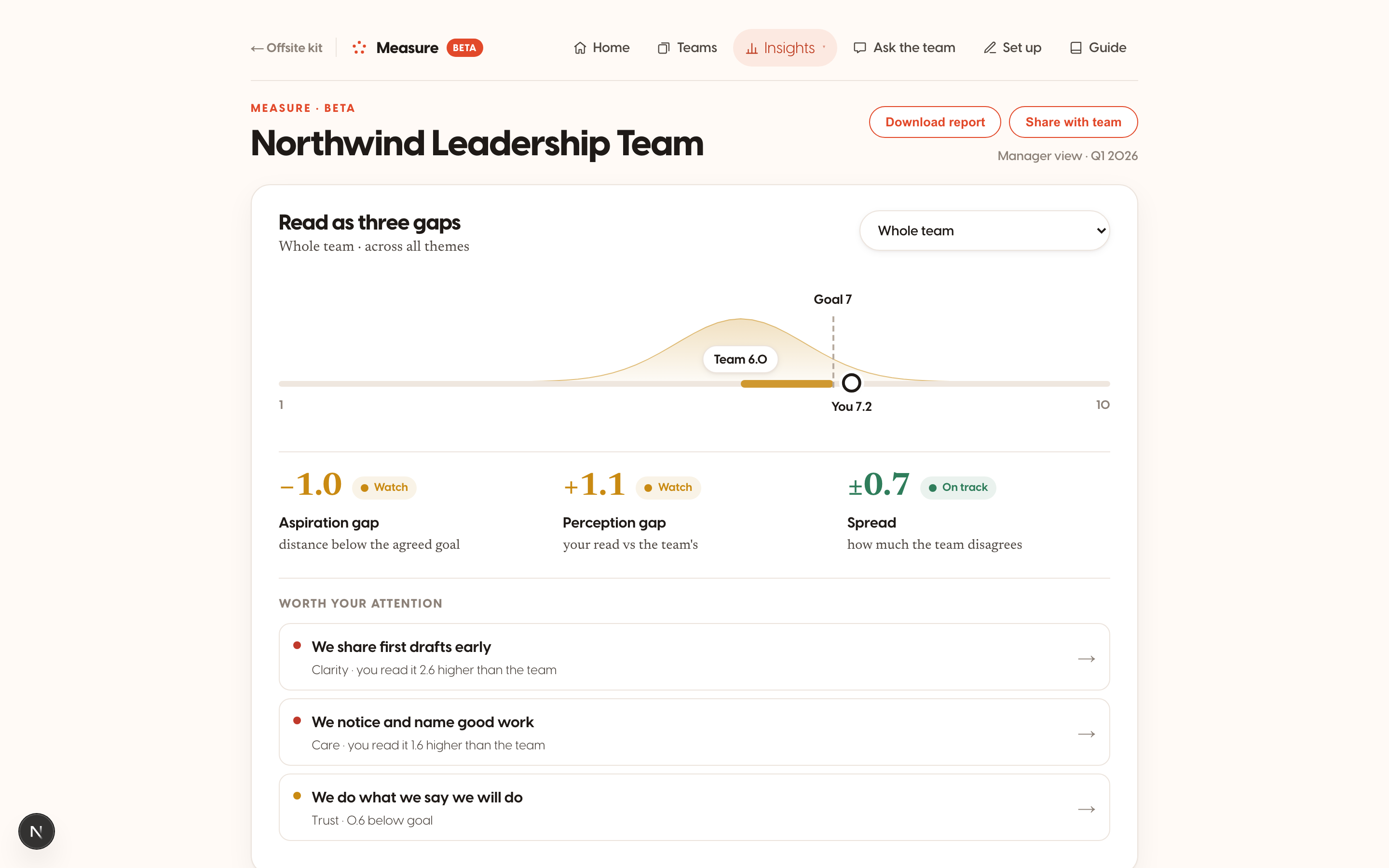
We built Measure to track the perception and aspiration gaps easily for your team. Before your team says a word, you put your own read on the record: for each behaviour you agreed matters, where do you honestly think the team sits on a scale of one to ten? Then the team answers the same questions, anonymously. Nothing appears until at least four people have responded, so no single person can ever be identified. You only ever see the team picture, never how any one person answered.
The results show three gaps side by side: the aspiration gap, how far the team is from the goal you set; the perception gap, how far your read is from theirs; and the spread, how much your team's own answers vary. It highlights the different experiences within the team and gives you a starting point for an impactful conversation about closing the gap and creating the culture you want.
The research behind this
- Fleenor, J. W., Smither, J. W., Atwater, L. E., Braddy, P. W., & Sturm, R. E. (2010). Self-other rating agreement in leadership: A review. The Leadership Quarterly, 21(6). Link
- Atwater, L. E., Ostroff, C., Yammarino, F. J., & Fleenor, J. W. (1998). Self-other agreement: Does it really matter? Personnel Psychology, 51(3). Link
- Eurich, T. (2018). What Self-Awareness Really Is (and How to Cultivate It). Harvard Business Review. Link
- Beck, R., & Harter, J. (2015). Managers Account for 70% of Variance in Employee Engagement. Gallup. Link
- Sull, D., Turconi, S., & Sull, C. (2020). When It Comes to Culture, Does Your Company Walk the Talk? MIT Sloan Management Review. Link
- Smither, J. W., London, M., & Reilly, R. R. (2005). Does performance improve following multisource feedback? Personnel Psychology, 58(1). Link
- Ashford, S. J., & Tsui, A. S. (1991). Self-regulation for managerial effectiveness: The role of active feedback seeking. Academy of Management Journal, 34(2).
- Argyris, C., & Schön, D. A. (1974). Theory in Practice: Increasing Professional Effectiveness. Jossey-Bass.
- Schein, E. H. (2010). Organizational Culture and Leadership (4th ed.). Jossey-Bass.
- Kaplan, R. S., & Norton, D. P. (1996). The Balanced Scorecard. Harvard Business School Press.
- McCrindle Research & Hatton, S. (2021). Let's Talk Culture: an organisational culture study of 1,002 Australian managers and team leaders.